6 Breathtaking Golf Course Aerial Views That Show Why Design Is Everything
Picture this: you’re soaring 1,000 feet above the world’s most spectacular golf courses, watching emerald fairways snake through ancient dunes, pristine lakes mirror the sky, and strategic bunkers create shadows that tell stories of championship drama. From this bird’s-eye perspective, golf course architecture reveals its true artistry—a masterful blend of strategy, beauty, and environmental harmony that transforms raw land into sporting masterpieces. These 6 breathtaking golf course aerial views that show why design is everything demonstrate how the world’s greatest golf architects think beyond individual holes to create complete symphonies of landscape and challenge.

Key Takeaways
- Strategic Design Mastery: Aerial views reveal how top golf architects use elevation changes, water features, and natural terrain to create both visual drama and strategic shot-making challenges
- Environmental Integration: The best golf course designs seamlessly blend with existing landscapes, enhancing rather than disrupting natural ecosystems and topography
- Visual Storytelling: From above, golf courses tell compelling stories through their routing, with each hole flowing naturally into the next while maintaining unique character and challenge
- Championship Legacy: Iconic aerial perspectives showcase how thoughtful design creates memorable tournament moments and tests the world’s best players across decades
- Sustainable Beauty: Modern golf course architecture prioritizes environmental stewardship while delivering breathtaking aesthetics that enhance the surrounding landscape
The Art of Golf Course Architecture: Why Aerial Perspectives Matter
Golf course design represents one of the most complex forms of landscape architecture, requiring architects to balance aesthetic beauty, strategic challenge, and environmental responsibility across hundreds of acres. When viewed from ground level, golfers experience individual holes and immediate tactical decisions. However, aerial photography reveals the grand design philosophy that connects every element into a cohesive masterpiece.
Professional golf course architects spend years studying topographical maps, analyzing drainage patterns, and understanding how sunlight moves across terrain throughout different seasons. They consider prevailing wind directions, natural vegetation, and existing wildlife habitats to create courses that feel like they’ve existed for centuries rather than being imposed upon the landscape[1].
The most successful golf course designs achieve what architects call “strategic architecture”—layouts that reward skilled shot-making while offering multiple routes to success. From aerial perspectives, these design principles become crystal clear, showing how bunker placement, green complexes, and fairway angles work together to create what golf legend Bobby Jones called “a thinking man’s game.”
1. Augusta National Golf Club: The Masters of Strategic Beauty
Location: Augusta, Georgia, USA
Architect: Alister MacKenzie and Bobby Jones
Established: 1933
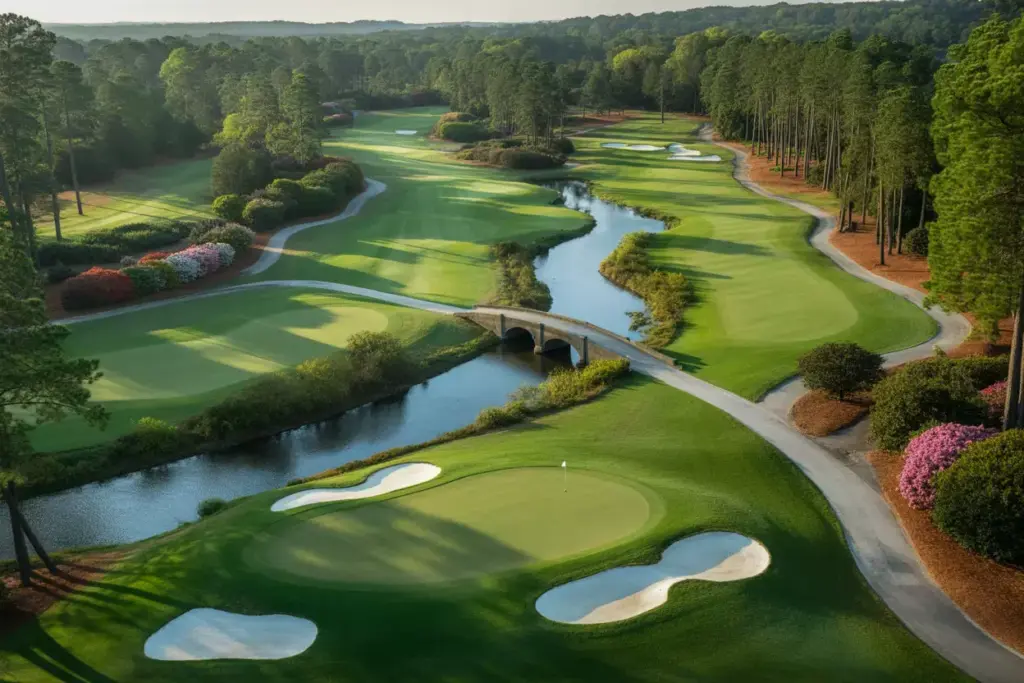
From 1,500 feet above Augusta National, the strategic genius of golf’s most famous venue becomes unmistakable. The aerial view reveals how MacKenzie and Jones created risk-reward opportunities throughout the property, with Amen Corner (holes 11, 12, and 13) forming a dramatic crescendo that has decided countless Masters tournaments.
The 12th hole, known as “Golden Bell,” appears deceptively simple from above—a short par-3 over Rae’s Creek. However, the aerial perspective shows how swirling wind patterns created by the surrounding trees and elevation changes make club selection a psychological battle. The green’s subtle slopes and strategic pin positions become evident when viewed from above, explaining why this 155-yard hole has destroyed more Masters dreams than any other[2].
Key Design Elements Visible from Above:
- Azalea-lined fairways that frame each hole while providing natural beauty
- Strategic mounding that creates blind shots and adds visual interest
- Creek systems that weave through multiple holes, creating continuous water hazards
- Elevation changes of over 100 feet across the property, adding dramatic vistas
The 13th hole “Azalea” showcases MacKenzie’s philosophy of “strategic architecture” perfectly. From above, golfers can see how the dogleg left around the creek creates multiple playing angles, with longer hitters able to cut more corner for shorter approaches to the green. The pine straw areas and flowering shrubs frame each shot while the Hogan Bridge serves as both functional crossing and aesthetic focal point.
2. Pebble Beach Golf Links: Coastal Drama Meets Strategic Design

Location: Pebble Beach, California, USA
Architects: Jack Neville and Douglas Grant
Established: 1919
The aerial view of Pebble Beach Golf Links reveals one of golf’s most spectacular marriages between natural landscape and strategic design. Eight holes play directly along the Pacific Ocean, with Carmel Bay providing both breathtaking beauty and severe penalty for wayward shots.
From above, the 7th hole appears as a perfect amphitheater carved from coastal bluffs. This 106-yard par-3 plays to a green perched 80 feet above the ocean, with Seal Point providing a dramatic backdrop. The aerial perspective shows how onshore winds and elevation changes can turn this short hole into one of golf’s most demanding challenges during tournament play.
Unique Coastal Design Features:
- Cliff-top fairways that require precise distance control
- Natural bunkers formed by coastal erosion over thousands of years
- Ice plant and Monterey pine that frame holes while providing wind protection
- Rocky shoreline that creates both beauty and strategic challenge
The 18th hole at Pebble Beach demonstrates how natural amphitheaters can create unforgettable tournament drama. From aerial views, the hole’s strategic options become clear: longer hitters can attempt to carry the Pacific Ocean for shorter approaches, while conservative players must navigate fairway bunkers and coastal rough for longer second shots to the green.
3. St. Andrews Old Course: Ancient Links Architecture Perfected

Location: St. Andrews, Scotland
Architect: Nature and centuries of evolution
Established: 15th century
The aerial view of St. Andrews Old Course reveals golf architecture in its purest form—a layout shaped by centuries of natural evolution rather than modern earth-moving equipment. From above, the shared fairways and double greens create a unique routing that has influenced golf course design worldwide.
The famous Road Hole (17th) appears from aerial perspective as a masterpiece of strategic complexity. The hole’s blind tee shot over the Old Course Hotel requires precise positioning to set up approaches to a green protected by the Road Hole Bunker and the actual road that gives the hole its name. From above, golfers can see how the prevailing wind from the North Sea affects every shot, making local knowledge invaluable[3].
Historic Design Elements:
- Shared fairways that create unique strategic decisions
- Pot bunkers positioned at key strategic points
- Double greens that serve multiple holes
- Natural undulations created by centuries of coastal weather
The Valley of Sin fronting the 18th green becomes particularly dramatic when viewed from above. This natural depression has swallowed countless approach shots over the centuries, demonstrating how links golf uses natural terrain features as strategic elements rather than manufactured hazards.
Understanding How These Breathtaking Golf Course Aerial Views Showcase Design Excellence
The three courses examined above represent different design philosophies and environmental contexts, yet each demonstrates how thoughtful architecture creates lasting appeal and strategic interest. When analyzing these breathtaking golf course aerial views, several common principles emerge that separate great courses from merely good ones.
Strategic Variety and Shot Values
Great golf course design provides multiple ways to play each hole, with risk-reward decisions that scale appropriately for different skill levels. From aerial perspectives, these strategic options become clearly visible through:
- Multiple tee positions that change hole angles and distances
- Fairway widths that vary based on optimal approach angles
- Hazard placement that punishes poor execution while rewarding bold play
- Green complexes with multiple pin positions and strategic approaches
Environmental Integration and Sustainability
Modern golf course architecture prioritizes environmental stewardship while maintaining championship-quality playing conditions. Aerial views reveal how successful courses:
- Preserve existing vegetation and natural water features
- Minimize earth movement to reduce construction impact
- Create wildlife corridors that support local ecosystems
- Use native grasses and plants that require less irrigation and maintenance
4. Cypress Point Club: Dramatic Coastline Architecture

Location: Pebble Beach, California, USA
Architect: Alister MacKenzie
Established: 1928
The aerial view of Cypress Point Club showcases MacKenzie’s ability to route golf holes through some of the world’s most dramatic coastal terrain. The course’s 16th hole, a 233-yard par-3 across a Pacific Ocean inlet, appears from above as pure architectural theater—a shot that requires carrying crashing waves and jagged rocks to reach a green perched on the opposite bluff.
From aerial perspective, the strategic brilliance of Cypress Point becomes evident in how MacKenzie used natural elevation changes and coastal features to create holes that feel both intimidating and inspiring. The 15th hole winds through Monterey cypress trees before opening to ocean views, while the 17th hole provides a brief respite before the challenging 18th that plays back toward the clubhouse.
Architectural Highlights:
- Ocean carries that test both skill and courage
- Cypress tree corridors that frame shots and create strategic angles
- Natural rock formations incorporated as hazards and visual elements
- Elevation changes exceeding 200 feet across the routing
5. Royal County Down: Links Golf in Natural Amphitheater

Location: Newcastle, Northern Ireland
Architects: Tom Morris Sr. and Harry Vardon
Established: 1889
The aerial view of Royal County Down reveals one of golf’s most spectacular natural settings, with the Mountains of Mourne providing a dramatic backdrop to traditional links golf. From above, the course’s routing through massive sand dunes creates a series of natural amphitheaters where each hole feels completely isolated from the others.
The 9th hole at Royal County Down demonstrates classic links architecture when viewed from aerial perspective. The blind tee shot over towering dunes requires local knowledge and strategic positioning, while the approach shot to a green nestled between natural bunkers and gorse bushes demands precise distance control and club selection.
Links Design Features:
- Natural dune systems that create strategic blindness and challenge
- Gorse and heather that provide both beauty and severe penalties
- Prevailing winds from the Irish Sea that affect every shot
- Firm and fast conditions that emphasize ground game and strategic thinking
6. Shinnecock Hills Golf Club: American Links Heritage

Location: Southampton, New York, USA
Architect: William Flynn (redesign)
Established: 1891
The aerial view of Shinnecock Hills showcases American links golf at its finest, with rolling fairways and fescue grasses creating playing conditions reminiscent of Scottish highlands. From above, Flynn’s strategic design becomes evident in how fairway angles and green positions reward precise positioning over pure distance.
The 16th hole at Shinnecock demonstrates how elevation changes and natural terrain can create strategic complexity without artificial features. From aerial perspective, the hole’s uphill approach to a plateau green protected by deep bunkers and native grasses requires both distance control and strategic thinking about wind conditions and pin positions.
Strategic Design Elements:
- Fescue rough that penalizes wayward shots while maintaining natural beauty
- Plateau greens that require precise approach shots
- Strategic bunkering positioned at key decision points
- Natural windswept conditions that change daily playing strategies
The Future of Golf Course Design: Lessons from Aerial Perspectives
These 6 breathtaking golf course aerial views that show why design is everything provide valuable insights for future golf course development and renovation projects. Modern architects study these aerial perspectives to understand how strategic design principles and environmental integration create courses that remain challenging and beautiful across decades of play.
Sustainable Design Practices
Contemporary golf course architecture emphasizes environmental responsibility while maintaining championship playing conditions. Aerial views help architects identify:
- Natural drainage patterns that reduce irrigation needs
- Existing vegetation that can be preserved and enhanced
- Wildlife habitats that should be protected during construction
- Soil conditions that affect grass selection and maintenance requirements
Technology and Design Innovation
Modern GPS technology and drone photography allow architects to study potential sites with unprecedented detail before beginning design work. These tools help create courses that:
- Minimize environmental impact through precise planning
- Optimize strategic challenge through detailed terrain analysis
- Enhance visual appeal by identifying the best natural features
- Improve playability for golfers of all skill levels
Conclusion: Why Design Excellence Creates Lasting Legacy
These breathtaking golf course aerial views demonstrate that great golf course architecture transcends mere strategic challenge to create lasting works of art that enhance their natural environments while providing memorable experiences for players of all abilities. From Augusta National’s strategic beauty to St. Andrews’ historic links character, each course showcases how thoughtful design creates emotional connections between golfers and the landscape.
The aerial perspectives of these championship venues reveal design principles that remain relevant for modern golf course development: strategic variety, environmental integration, visual appeal, and sustainable maintenance practices. Whether planning a new course construction or renovation project, these examples provide blueprints for creating golf experiences that will inspire players for generations.
Next Steps for Golf Course Enthusiasts:
- Study aerial photography of your favorite courses to better understand strategic design elements
- Research the architects behind great courses to learn their design philosophies
- Visit multiple course styles (links, parkland, desert, mountain) to appreciate different design approaches
- Support sustainable golf practices by choosing courses that prioritize environmental stewardship
- Share your aerial photography and course reviews to help others discover architectural excellence
The legacy of great golf course design lies not just in championship tournaments or famous moments, but in the daily inspiration these courses provide to golfers who appreciate the artistry and strategic thinking that transforms natural landscapes into sporting masterpieces. These aerial views remind us that golf course architecture represents one of humanity’s most successful collaborations with the natural world, creating beauty, challenge, and environmental harmony that enriches both local communities and global golf culture.
References
[1] Golf Course Architecture Magazine, “Strategic Design Principles in Modern Golf Course Development,” 2024.
[2] Masters Tournament Official History, “Amen Corner: Architecture and Tournament Drama,” Augusta National Golf Club, 2023.
[3] St. Andrews Links Trust, “The Old Course: Evolution of Links Golf Architecture,” 2024.