8 Essential Golf Club Types Explained: Find Your Perfect Fit
Standing on the first tee with a bag full of golf clubs can feel overwhelming, especially when each club seems to have its own mysterious purpose and optimal use case. Whether you’re a beginner trying to understand the basics or an experienced golfer looking to refine your equipment knowledge, mastering the 8 Essential Golf Club Types Explained: Find Your Perfect Fit will transform your game from guesswork into strategic precision. 🏌️♂️

Understanding golf club types isn’t just about knowing their names—it’s about unlocking the potential for better shots, lower scores, and more enjoyable rounds. Each club in your bag serves a specific purpose, from the powerful driver that launches your ball down the fairway to the precise wedges that help you navigate tricky situations around the green.
Key Takeaways
- Woods and drivers are designed for maximum distance with large heads and long shafts, perfect for tee shots and long fairway approaches
- Irons provide versatility across multiple distances, with long irons for distance and short irons for precision approach shots
- Hybrid clubs combine the best features of woods and irons, offering improved forgiveness and easier launch characteristics
- Wedges specialize in short-game precision with high loft angles ranging from 46-64 degrees for various situations around the green
- Proper club selection based on distance, lie, and course conditions can dramatically improve scoring and overall game enjoyment
Understanding Golf Club Categories: The Foundation of Your Game
Golf clubs fall into four main categories, each engineered for specific situations and shot requirements. The 8 Essential Golf Club Types Explained: Find Your Perfect Fit approach begins with understanding how these categories work together to create a complete golfing arsenal.
Woods feature the largest club heads and longest shafts, designed primarily for distance. Irons offer the most versatility with their angled faces and varying loft degrees. Hybrids bridge the gap between woods and irons with innovative design features. Finally, wedges provide specialized short-game solutions with extreme loft angles for precision shots around the green.
Modern golf club design has evolved significantly over the past decades, with manufacturers using advanced materials like titanium, carbon fiber, and specialized steel alloys to optimize performance. Understanding these technological improvements helps golfers make informed decisions when building their ideal set.
“The right golf club in the right situation can turn a challenging shot into a confident stroke. It’s not about having the most expensive clubs—it’s about having the right clubs for your game.” – PGA Teaching Professional
1. Driver: The Powerhouse of Distance

The driver, also known as the 1-wood, represents the most specialized club in any golfer’s bag. Engineered specifically for maximum distance off the tee, drivers feature the largest club head (up to 460 cubic centimeters) and the longest shaft, typically ranging from 44 to 46 inches [1].
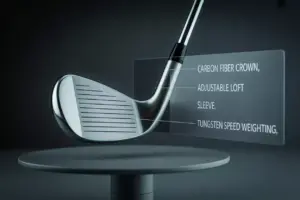
Modern drivers utilize titanium construction to achieve an optimal strength-to-weight ratio, allowing manufacturers to create larger, more forgiving club heads without adding excessive weight. The face of a driver typically features a loft angle between 8-12 degrees, designed to launch the ball at the ideal trajectory for maximum carry distance.
Key Driver Characteristics:
- Largest club head size for maximum forgiveness
- Longest shaft for increased clubhead speed
- Lowest loft angle for optimal launch conditions
- Adjustable features for customizing ball flight
The sweet spot on a driver, while larger than traditional clubs, still requires proper contact for optimal performance. Advanced drivers often include adjustable weights and loft settings, allowing golfers to fine-tune their ball flight characteristics based on swing speed and course conditions.
2. Fairway Woods: Versatile Distance Solutions

Fairway woods (typically 3-wood, 5-wood, and 7-wood) offer golfers reliable distance options from various lies throughout the course. These clubs feature higher loft angles and shallower face heights compared to drivers, making them more versatile for shots from the fairway, rough, or even tee boxes on shorter holes [2].
The 3-wood, with loft angles typically ranging from 13-16 degrees, serves as an excellent alternative to the driver on tight fairways or when accuracy takes precedence over maximum distance. The 5-wood (17-20 degrees) and 7-wood (21-24 degrees) provide even more loft for easier launch and softer landing characteristics.
Fairway Wood Applications:
- Tee shots on narrow or shorter holes
- Long approach shots from the fairway
- Recovery shots from light rough
- Punch shots under tree branches
The center of gravity in fairway woods sits lower and deeper than in drivers, promoting easier launch and more consistent ball striking from various lies. This design characteristic makes fairway woods particularly valuable for golfers who struggle with long iron consistency.
3. Long Irons: Precision at Distance
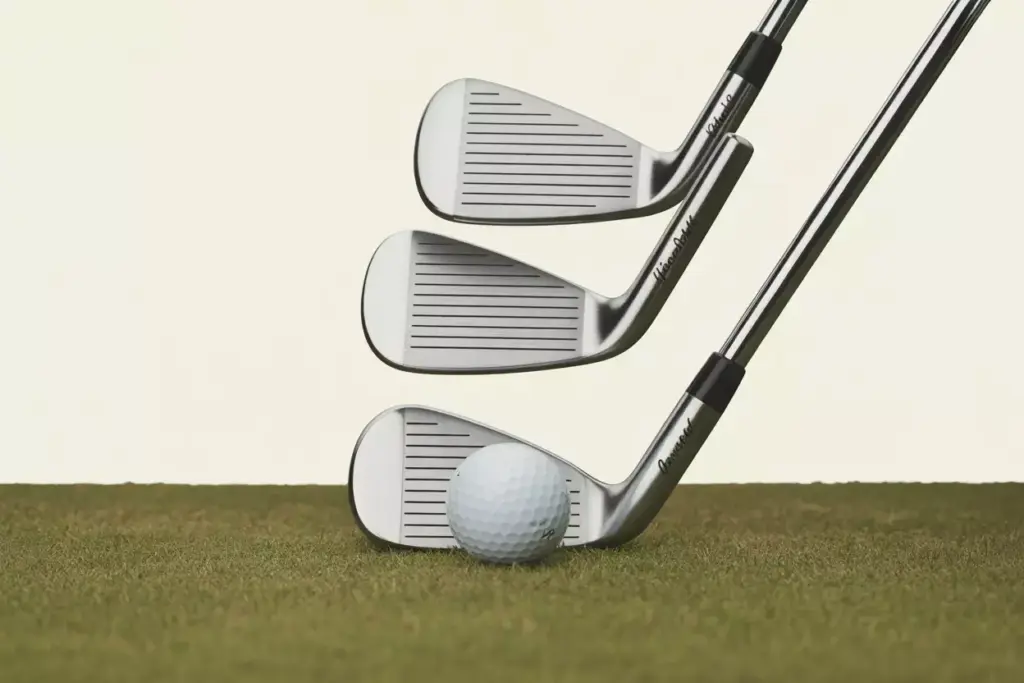
Long irons (2-iron through 4-iron) occupy a unique position in the modern golf bag, offering distance capabilities while maintaining the control characteristics inherent in iron design. However, the 2-iron has become increasingly rare due to its smaller sweet spot and the skill level required for consistent ball striking [3].
The 3-iron typically features 18-22 degrees of loft, while the 4-iron ranges from 22-26 degrees. These clubs require precise contact and consistent swing mechanics to achieve optimal performance, making them more suitable for skilled golfers who can consistently strike the ball cleanly.
Long Iron Advantages:
- Lower ball flight for windy conditions
- Increased control compared to woods
- Better accuracy from tight lies
- Workability for shot shaping
Many golfers have replaced their long irons with hybrid clubs, which offer similar distance with improved forgiveness and easier launch characteristics. However, skilled players often prefer long irons for their shot-shaping capabilities and penetrating ball flight.
4. Mid Irons: The Workhorses of Golf

Mid irons (5-iron through 7-iron) represent the most frequently used clubs in most golfers’ bags, offering an ideal balance of distance and control for approach shots to the green. These clubs typically feature loft angles ranging from 26-34 degrees, providing optimal trajectory for green-holding approach shots [4].
The 5-iron serves as a transition club between long irons and scoring irons, while the 6-iron and 7-iron become increasingly important for precision approach play. Modern mid irons often incorporate perimeter weighting and cavity-back designs to enhance forgiveness without sacrificing feel.
Mid Iron Characteristics:
- Versatile distance range (130-170 yards for average golfers)
- Optimal trajectory for green approach shots
- Enhanced forgiveness through design improvements
- Consistent gapping for distance control
The progressive design of mid irons means each club features slightly more loft, shorter shaft length, and increased offset compared to longer irons. This progression creates predictable distance gaps and helps golfers develop consistent swing mechanics across multiple clubs.
5. Short Irons: Precision Scoring Tools

Short irons (8-iron and 9-iron) represent the precision instruments of golf, designed for accuracy over distance when approaching the green from closer ranges. These clubs feature the highest loft angles among traditional irons (typically 34-42 degrees) and the shortest shaft lengths for maximum control [5].
The design philosophy behind short irons emphasizes spin generation and trajectory control, allowing golfers to attack pin positions with confidence. The increased loft creates higher ball flight and steeper descent angles, helping shots hold the green even on firm surfaces.
Short Iron Applications:
- Approach shots from 100-130 yards
- Punch shots from under trees
- Knockdown shots in windy conditions
- Precision shots to tight pin positions
Modern short irons often feature enhanced groove designs to maximize spin generation, particularly important for controlling ball flight and green-side performance. The combination of loft, grooves, and shorter shaft length makes short irons the most accurate clubs in most golfers’ bags.
6. Hybrid Clubs: The Modern Innovation
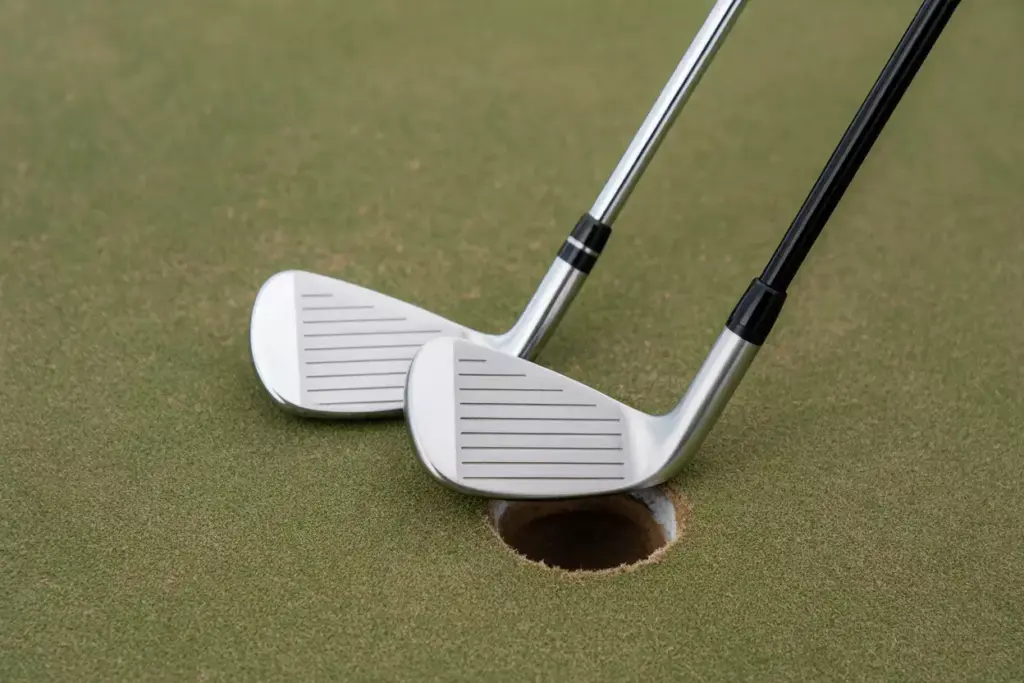
Hybrid clubs, first popularized by TaylorMade in 2003, revolutionized golf by combining the best characteristics of fairway woods and irons. These innovative clubs feature a shallow head design and lower center of gravity, offering improved power and precision compared to traditional long irons [6].
The hybrid design addresses common problems golfers face with long irons, including difficult launch conditions and small sweet spots. By incorporating wood-like characteristics into an iron-replacement club, hybrids provide easier launch, increased forgiveness, and improved performance from various lies.
Hybrid Advantages:
- Easier launch than comparable irons
- Increased forgiveness on off-center hits
- Better performance from rough lies
- Higher trajectory for green-holding shots
Most golfers carry hybrids in the 17-24 degree range, effectively replacing 2-irons through 5-irons depending on individual preferences and skill levels. The versatility of hybrids makes them suitable for tee shots, fairway approaches, and even recovery situations.
7. Wedge Varieties: Short Game Specialists
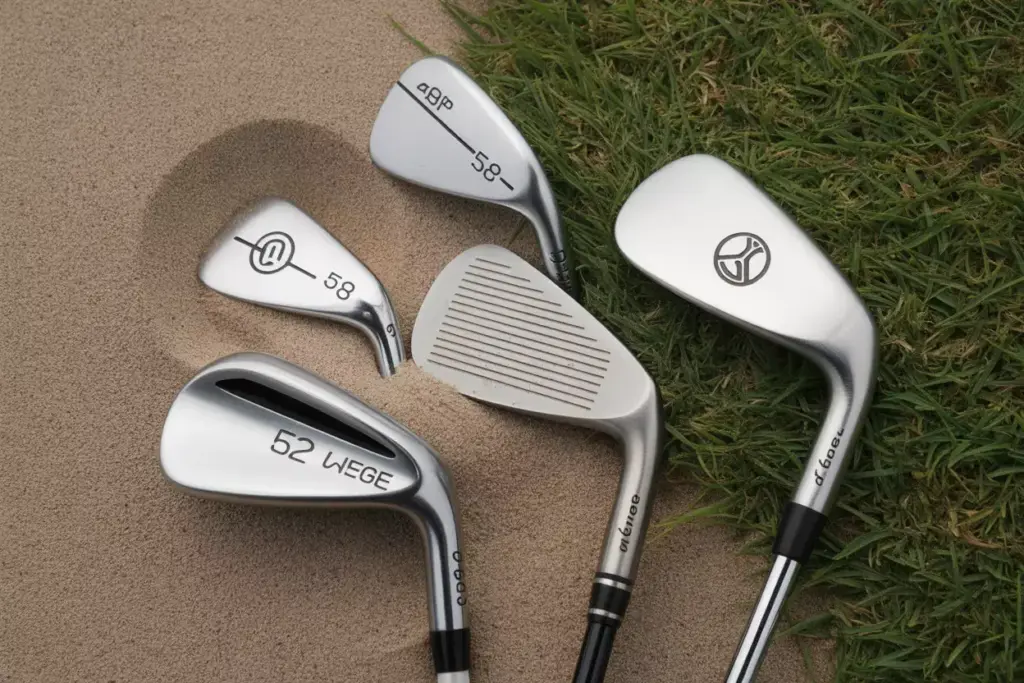
Wedges represent the most specialized category in the 8 Essential Golf Club Types Explained: Find Your Perfect Fit system, featuring pronounced loft angles ranging from 46-64 degrees. These clubs are specifically designed to generate maximum height while achieving soft landings on short-distance shots around the green [7].
Pitching Wedge (45-48 degrees)
The pitching wedge serves as the highest-lofted club in most iron sets, typically used within 100 yards of the hole for approach shots and chip shots onto the green. Modern pitching wedges often feature enhanced groove designs for increased spin generation.
Gap Wedge (50-52 degrees)
Gap wedges bridge the distance between pitching and sand wedges, providing optimal coverage for shots in the 100-120 yard range. This club fills a crucial distance gap that many golfers struggle with using only pitching and sand wedges.
Sand Wedge (54-56 degrees)
Sand wedges feature specialized design elements including increased bounce angles and wider soles to navigate effectively through sand bunkers. The bounce design prevents the club from digging too deeply into soft surfaces.
Lob Wedge (58-64 degrees)
Lob wedges feature the highest loft angles available, designed for shots requiring maximum height and minimal roll. These clubs excel in situations requiring the ball to clear obstacles and land softly on the green.
8. Putter: The Scoring Finalizer
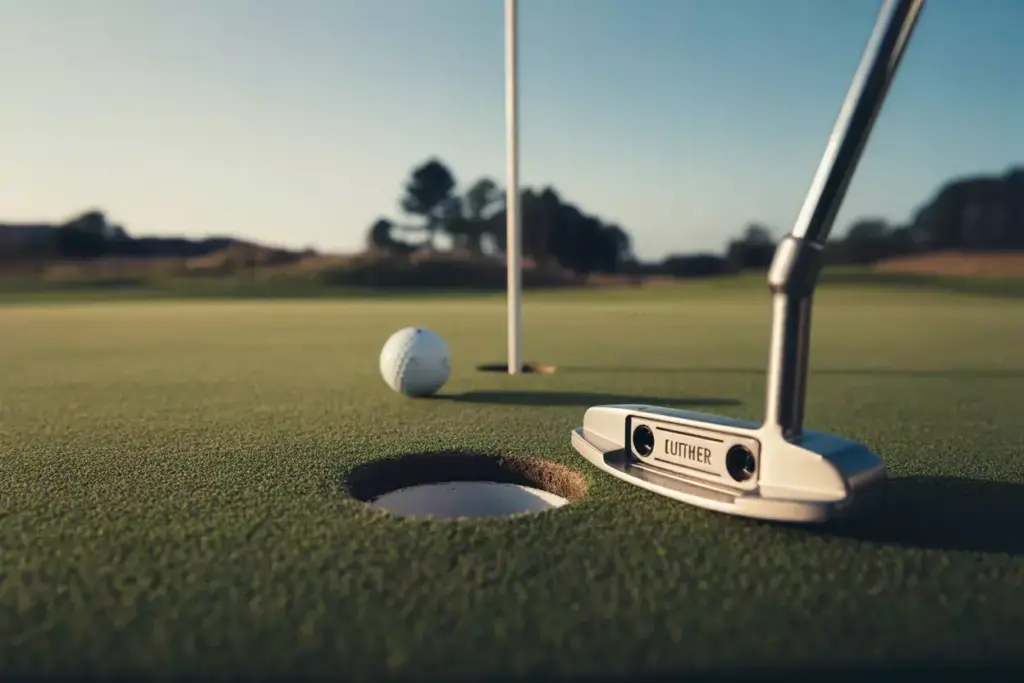
The putter represents perhaps the most important club for scoring, as it’s used on every hole and accounts for approximately 40% of all shots in a typical round. Unlike other clubs designed for distance or trajectory, putters focus exclusively on accuracy and distance control on the green surface [8].
Putter Design Variations:
- Blade putters for traditional feel and feedback
- Mallet putters for increased forgiveness
- Insert technology for improved feel
- Alignment aids for setup consistency
Modern putter technology incorporates various face insert materials, weight distribution systems, and alignment features to help golfers achieve more consistent results on the green. The choice between different putter styles often comes down to personal preference and individual stroke characteristics.
Choosing the Right Golf Club Types for Your Game
Selecting the optimal combination from the 8 Essential Golf Club Types Explained: Find Your Perfect Fit requires careful consideration of individual skill level, physical capabilities, and playing preferences. Beginner golfers typically benefit from more forgiving club designs, while advanced players may prefer clubs offering greater workability and shot-shaping capabilities.
Factors to Consider:
- Swing speed and tempo
- Skill level and experience
- Physical attributes (height, strength)
- Course conditions typically played
- Budget and equipment priorities
Club fitting has become increasingly important in modern golf, with professional fitters using launch monitors and swing analysis technology to optimize club specifications for individual golfers. Proper fitting can result in significant improvements in distance, accuracy, and overall enjoyment of the game.
Building Your Ideal Golf Club Set
The 14-club maximum rule in golf requires strategic decisions about which clubs to include in your bag. Most golfers carry a driver, fairway wood (3-wood or 5-wood), several irons or hybrids, multiple wedges, and a putter. The exact composition depends on individual strengths, weaknesses, and course requirements.
Typical Club Set Composition:
- 1 Driver for maximum distance
- 1-2 Fairway woods for versatility
- 2-3 Hybrids replacing long irons
- 4-6 Irons (typically 6-iron through 9-iron)
- 3-4 Wedges for short game variety
- 1 Putter for green-side precision
Gapping between clubs becomes crucial for consistent distance control. Ideally, each club should provide 10-15 yard gaps to ensure proper coverage across all distances. Professional club fitting can help optimize these gaps based on individual swing characteristics.
Maintenance and Care for Your Golf Clubs
Proper maintenance extends the life and performance of golf clubs while ensuring optimal results on the course. Regular cleaning, groove maintenance, and grip replacement help maintain club performance and feel throughout their lifespan.
Essential Maintenance Practices:
- Clean grooves after each shot to maintain spin
- Dry clubs thoroughly to prevent rust
- Replace grips annually or as needed
- Check lie angles periodically
- Store properly to prevent damage
Grip condition significantly affects club performance and feel. Worn grips can lead to inconsistent hand pressure and reduced control, making regular replacement an important aspect of club maintenance.
Conclusion
Mastering the 8 Essential Golf Club Types Explained: Find Your Perfect Fit provides the foundation for improved performance and greater enjoyment on the golf course. Each club type serves specific purposes, from the distance-focused driver to the precision-oriented wedges, creating a complete system for navigating any golf course challenge.
The key to success lies not just in understanding what each club does, but in knowing when and how to use them effectively. This knowledge comes through practice, experience, and often professional instruction that helps golfers maximize their equipment potential.
Take Action Today:
- Assess your current club set for gaps or redundancies
- Schedule a professional club fitting to optimize your equipment
- Practice with each club type to understand their capabilities
- Develop course management strategies based on your club strengths
- Invest in proper maintenance tools to keep your clubs performing optimally
Remember that golf clubs are tools designed to help you play better golf. The 8 Essential Golf Club Types Explained: Find Your Perfect Fit approach ensures you have the right tool for every situation, transforming challenging shots into confident swings and ultimately leading to lower scores and more enjoyable rounds.
References
[1] United States Golf Association. “Equipment Rules: Clubs.” USGA.org, 2025.
[2] Golf Digest Equipment Team. “Fairway Wood Technology and Design Principles.” Golf Digest, 2025.
[3] PGA of America. “Iron Play Fundamentals and Club Selection.” PGA.com, 2025.
[4] Golf Magazine Technical Review. “Mid-Iron Performance Analysis.” Golf Magazine, 2025.
[5] Short Game Foundation. “Precision Iron Design and Performance Metrics.” SGF Research, 2025.
[6] TaylorMade Golf Company. “The Evolution of Hybrid Club Technology.” TaylorMade.com, 2025.
[7] Titleist Performance Institute. “Wedge Design and Short Game Performance.” TPI.com, 2025.
[8] Professional Golfers’ Association. “Putting Statistics and Equipment Analysis.” PGA Tour, 2025.