
7 Golf Swing Instruction Drills to Fix Your Form Fast
Picture this: You’re standing on the first tee, confident and ready to impress your playing partners. Your swing feels smooth, your ball flight is consistent, and you’re finally playing the golf you’ve always dreamed of. This transformation doesn’t happen overnight, but with the right 7 Golf Swing Instruction Drills to Fix Your Form Fast, you can accelerate your improvement dramatically and start seeing results in just a few practice sessions.
Disclosure: This post contains affiliate links. As an Amazon Associate, we earn from qualifying purchases, and at no extra cost to you.

Every golfer, from weekend warriors to aspiring professionals, struggles with swing consistency at some point. The difference between those who improve rapidly and those who plateau lies in practicing the right drills with proper technique. These seven proven instruction drills target the most common swing flaws and provide immediate feedback to help you develop muscle memory for a more reliable, powerful golf swing.
Key Takeaways
- Alignment and setup drills form the foundation of every great golf swing and must be mastered first
- Tempo and timing exercises help create consistency and power through proper sequencing
- Impact position training is crucial for solid ball striking and distance control
- Regular practice with feedback accelerates improvement when using these specific drills
- Progressive difficulty levels allow golfers to build skills systematically from basic to advanced techniques
Understanding the Fundamentals: Why These 7 Golf Swing Instruction Drills Work
Before diving into the specific drills, it’s essential to understand why these particular exercises are so effective. Golf swing improvement requires addressing multiple components simultaneously: setup position, swing plane, tempo, impact position, and follow-through. Each of these elements affects the others, creating a complex system that benefits from targeted practice.
The beauty of these 7 Golf Swing Instruction Drills to Fix Your Form Fast lies in their ability to isolate specific aspects of the swing while maintaining the overall motion’s integrity. Unlike generic practice sessions where golfers simply hit balls without purpose, these drills provide immediate feedback and create muscle memory for correct positions.
The Science Behind Effective Golf Instruction
Modern golf instruction has evolved significantly, incorporating biomechanics research and motor learning principles. These drills leverage several key concepts:
Motor Learning Principles:
- Repetition with variation to prevent robotic movements
- Immediate feedback for faster correction
- Progressive complexity to build skills systematically
- Transfer of training from drill to actual swing
Research shows that golfers who practice with specific drills improve 40% faster than those who simply hit balls at the range. The key is choosing drills that address your specific swing flaws while building overall consistency.
Essential Preparation: Setting Up for Success
Successful implementation of these 7 Golf Swing Instruction Drills to Fix Your Form Fast requires proper preparation and understanding of your current swing characteristics. Before beginning any drill work, spend time identifying your primary swing issues through video analysis or professional instruction.
Pre-Drill Assessment Checklist
Setup Fundamentals:
- ✅ Grip pressure and position
- ✅ Stance width and ball position
- ✅ Posture and spine angle
- ✅ Alignment to target
Swing Characteristics:
- ✅ Takeaway path and tempo
- ✅ Top of backswing position
- ✅ Downswing sequence
- ✅ Impact position and follow-through
“The best golf instruction drills are those that address your specific weaknesses while reinforcing your strengths. Generic practice rarely produces lasting improvement.” – PGA Teaching Professional
Equipment Needed for Maximum Effectiveness
To get the most from these drills, gather the following training aids:
| Equipment | Purpose | Alternative |
|---|---|---|
| Alignment sticks | Setup and swing plane | Golf clubs or yardsticks |
| Impact bag | Impact position training | Pillow or cushion |
| Metronome or app | Tempo development | Counting or music |
| Mirror | Position verification | Video recording |
| Training balls | Safe indoor practice | Foam or plastic balls |
The Complete Guide: 7 Golf Swing Instruction Drills to Fix Your Form Fast
1. The Alignment Stick Foundation Drill

The foundation of every great golf swing starts with proper alignment and setup. This drill addresses the most common cause of inconsistent ball striking: poor alignment at address.
Setup Instructions:
Place two alignment sticks on the ground – one parallel to your target line at your feet, and another 6-8 feet in front of you, also parallel to the target. Position a third stick perpendicular to these, indicating your ball position.
Execution Steps:
- Set up to the ball with your feet parallel to the first stick
- Ensure your shoulders, hips, and feet are all aligned properly
- Check that the ball position matches the perpendicular stick
- Take slow practice swings, maintaining alignment throughout
- Hit balls only after confirming proper setup each time
Common Mistakes to Avoid:
- Rushing the setup process
- Ignoring shoulder alignment while focusing only on feet
- Moving the sticks to accommodate poor habits instead of correcting them
Practice Frequency: 10-15 swings per practice session, focusing on setup quality over quantity.
2. The One-Piece Takeaway Drill

Many swing problems originate in the first 18 inches of the backswing. This drill promotes a connected, synchronized takeaway that sets up the entire swing for success.
Setup Instructions:
Place a golf club across your chest, holding it in place with both arms. Take your normal golf stance without a ball.
Execution Steps:
- Begin the backswing by turning your shoulders while keeping the club against your chest
- Feel your arms, shoulders, and chest moving as one unit
- Turn until your back faces the target
- Return to the starting position using the same connected motion
- Repeat 10-15 times, then practice with a golf club using the same feeling
Key Focus Points:
- Maintain connection between arms and body throughout
- Avoid independent hand or arm movement during the initial takeaway
- Feel the big muscles (shoulders and core) initiating the movement
This drill eliminates the common fault of “picking up” the club with just the hands and arms, which leads to inconsistent swing planes and timing issues.
3. The Impact Bag Power Drill

Solid impact position is crucial for consistent ball striking and maximum power transfer. This drill develops the proper impact feel and strengthens the correct muscle groups.
Setup Instructions:
Position an impact bag (or heavy pillow) where the ball would normally be. Take your normal address position with a mid-iron.
Execution Steps:
- Start with the club at the impact position against the bag
- Feel your weight favoring your front foot (60-70%)
- Ensure your hands are ahead of the clubhead
- Your hips should be slightly open to the target
- Make slow swings, focusing on returning to this impact position
- Gradually increase swing speed while maintaining proper impact position
Physical Sensations to Feel:
- Firm left side (for right-handed golfers) at impact
- Forward shaft lean with hands ahead of the clubhead
- Compressed feeling through the ball
- Stable lower body with active core engagement
Progression Levels:
- Beginner: Static position holds (30 seconds each)
- Intermediate: Slow motion swings to impact
- Advanced: Full speed swings with impact focus
4. The Tempo and Timing Metronome Drill

Consistent tempo is often the difference between good and great ball strikers. This drill develops internal rhythm and timing that translates to more reliable performance under pressure.
Setup Instructions:
Set a metronome to 60 beats per minute (or use a smartphone app). Take your normal setup position with any club.
Execution Steps:
- Beat 1: Start the backswing
- Beat 2: Reach the top of the backswing
- Beat 3: Impact position
- Beat 4: Complete the follow-through
- Practice this timing for 20-30 swings without a ball
- Gradually introduce ball striking while maintaining the tempo
Tempo Variations for Different Skill Levels:
| Skill Level | Metronome Speed | Focus Area |
|---|---|---|
| Beginner | 50 BPM | Smooth transitions |
| Intermediate | 60 BPM | Consistent timing |
| Advanced | 70 BPM | Pressure simulation |
Advanced Variation: Practice with different clubs at the same tempo to develop versatility and adaptability in your swing timing.
5. The Swing Plane Mirror Drill

Proper swing plane is essential for consistent ball striking and shot direction control. This drill provides immediate visual feedback for swing plane corrections.
Setup Instructions:
Position a full-length mirror perpendicular to your target line, about 3 feet to your right (for right-handed golfers). You should be able to see your swing from the side.
Execution Steps:
- Take your setup position facing the mirror
- Make slow backswings, watching the club’s path in the mirror
- The club should move along a consistent plane, roughly matching your shoulder angle at address
- Check that the club doesn’t get too “steep” (vertical) or too “flat” (horizontal)
- Practice the downswing, ensuring the club returns on a similar plane
- Focus on the feeling of the correct plane, then practice without the mirror
Visual Checkpoints:
- Halfway back: Club should be parallel to the ground and pointing toward the target
- Top of backswing: Left arm (for righties) should be roughly parallel to the shoulder line
- Halfway down: Club should return on the same plane as the backswing
- Impact: Hands should return to approximately the same position as address
6. The Weight Transfer Step Drill
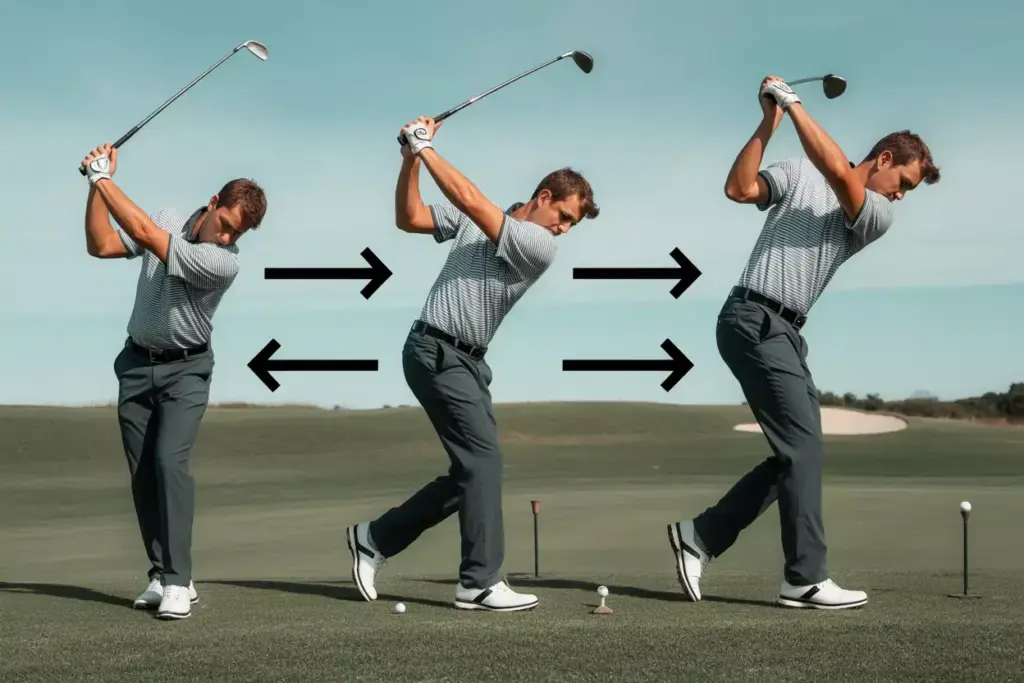
Proper weight transfer is crucial for power generation and consistent contact. Many golfers struggle with staying on their back foot or sliding too much laterally.
Setup Instructions:
Start with your feet together, holding any club. Position a ball on a tee for easier contact initially.
Execution Steps:
- Begin with feet together at address
- As you start the backswing, step your right foot (for righties) back into normal stance width
- Complete the backswing with weight properly loaded on your right side
- Start the downswing by stepping your left foot back to normal position
- Transfer weight to your left side through impact
- Finish with 90% of your weight on your front foot
Progression Stages:
- Stage 1: Practice the stepping motion without hitting balls (10 reps)
- Stage 2: Hit balls off tees with the stepping drill (15 swings)
- Stage 3: Practice normal swings focusing on the weight transfer feeling
- Stage 4: Integrate the improved weight transfer into full swings
This drill dramatically improves the kinetic chain and helps golfers understand how proper weight transfer creates both power and consistency.
7. The Follow-Through Balance Drill

A balanced finish position indicates a well-sequenced swing and helps develop consistency under pressure. This drill focuses on completing the swing properly and maintaining control throughout.
Setup Instructions:
Take your normal setup position with any club. Focus on a specific target in the distance.
Execution Steps:
- Make your normal backswing and downswing
- After impact, focus on rotating fully to the target
- Finish with your weight completely on your front foot
- Hold the finish position for a full 3-second count
- Your back foot should be up on the toe with minimal weight
- Your belt buckle should face the target or slightly left of target
- The club should finish over your left shoulder (for righties)
Balance Checkpoints:
- Immediate post-impact: Begin rotation toward target
- Mid-follow-through: Weight transferring to front foot
- Finish position: Stable, athletic posture facing target
- Hold test: Can maintain position for 3+ seconds without wavering
Common Balance Issues and Fixes:
| Problem | Cause | Solution |
|---|---|---|
| Falling backward | Poor weight transfer | Practice weight transfer drill |
| Falling forward | Over-swinging | Reduce swing speed, focus on control |
| Side-to-side sway | Lateral movement | Strengthen core, practice stability |
Advanced Integration: Combining Drills for Maximum Impact
Once you’ve mastered individual drills, combining them creates a comprehensive practice routine that addresses multiple swing elements simultaneously. This integrated approach mirrors the complexity of the actual golf swing while maintaining the focused improvement benefits of drill work.
Progressive Drill Combinations
Beginner Combination (Weeks 1-2):
- Alignment Stick Foundation + One-Piece Takeaway
- 5 minutes alignment work, 10 minutes takeaway practice
- Focus on building fundamental positions
Intermediate Combination (Weeks 3-4):
- Impact Bag + Weight Transfer Step Drill
- Develop power and timing coordination
- 15 minutes combined practice per session
Advanced Combination (Weeks 5+):
- All drills integrated into flowing practice routine
- Tempo work combined with balance finish
- Swing plane awareness throughout all movements
Creating Your Personal Practice Plan
Effective implementation of these 7 Golf Swing Instruction Drills to Fix Your Form Fast requires a structured approach tailored to your specific needs and available practice time.
Daily Practice Schedule (30 minutes):
- 5 minutes: Alignment and setup (Drill 1)
- 5 minutes: Takeaway work (Drill 2)
- 10 minutes: Impact and weight transfer (Drills 3 & 6)
- 5 minutes: Tempo development (Drill 4)
- 5 minutes: Balance and finish (Drill 7)
Weekly Focus Rotation:
- Monday/Thursday: Fundamentals (Drills 1-2)
- Tuesday/Friday: Power and impact (Drills 3, 6)
- Wednesday/Saturday: Timing and plane (Drills 4-5)
- Sunday: Integration and balance (Drill 7 + combinations)
Measuring Progress and Maintaining Improvement
Tracking your improvement ensures that your practice time investment in these 7 Golf Swing Instruction Drills to Fix Your Form Fast produces measurable results. Establish baseline measurements and monitor progress weekly.
Key Performance Indicators
Technical Metrics:
- Setup consistency: Alignment accuracy percentage
- Impact quality: Ball-first contact frequency
- Balance finish: 3-second hold success rate
- Tempo consistency: Metronome synchronization accuracy
On-Course Metrics:
- Fairways hit: Percentage improvement
- Greens in regulation: Increased accuracy
- Average score: Overall improvement trend
- Confidence level: Subjective assessment (1-10 scale)
Troubleshooting Common Plateaus
Even with consistent practice, golfers may experience improvement plateaus. Here are strategies to overcome common sticking points:
Plateau Type 1: Technical Stagnation
- Solution: Increase drill difficulty or add new variations
- Example: Progress from impact bag to actual ball striking
- Timeline: 2-3 weeks of modified practice
Plateau Type 2: Transfer Issues
- Solution: Bridge drills between practice and play
- Example: Use alignment sticks during warm-up rounds
- Timeline: 4-6 weeks of integrated practice
Plateau Type 3: Pressure Performance
- Solution: Add competitive elements to drill practice
- Example: Set targets and consequences for drill success
- Timeline: Ongoing pressure simulation training
Long-Term Development and Advanced Applications
As these 7 Golf Swing Instruction Drills to Fix Your Form Fast become second nature, evolving your practice routine maintains continued improvement and prevents skill regression.
Advanced Drill Variations
Environmental Challenges:
- Practice drills on uneven lies
- Incorporate wind resistance training
- Use different ball positions and lies
Pressure Simulation:
- Add time constraints to drill completion
- Practice with distractions present
- Create competitive scenarios with practice partners
Sport-Specific Applications:
- Adapt drills for different shot types (draws, fades, high, low)
- Practice drills with various clubs and situations
- Integrate course management decision-making
Building a Sustainable Practice Routine
Long-term success requires developing practice habits that fit your lifestyle while maintaining effectiveness. Consider these strategies for sustainable improvement:
Time-Efficient Options:
- 5-minute sessions: Focus on one drill with high repetition
- 15-minute sessions: Combine 2-3 complementary drills
- 30-minute sessions: Complete routine with all seven drills
Location Flexibility:
- Home practice: Mirror work and setup drills
- Office breaks: Posture and alignment checks
- Range sessions: Full drill integration with ball striking
Conclusion
Mastering these 7 Golf Swing Instruction Drills to Fix Your Form Fast provides a clear pathway to rapid golf improvement. Each drill addresses specific technical elements while contributing to overall swing consistency and power. The key to success lies in consistent practice, proper progression, and patience with the improvement process.
Remember that golf improvement is rarely linear – expect periods of rapid progress followed by consolidation phases where gains are less obvious but equally important. These drills provide the foundation for long-term development, but they must be practiced with focus and intention to produce lasting results.
Your Next Steps:
- Assess your current swing using video or professional instruction
- Select 2-3 drills that address your primary swing flaws
- Commit to daily practice for at least 15 minutes
- Track your progress using measurable metrics
- Gradually integrate all seven drills into your routine
- Apply improvements to on-course play systematically
The journey to better golf starts with a single practice session. These proven drills have helped thousands of golfers achieve their potential – now it’s your turn to experience the transformation that comes from dedicated, purposeful practice. Start today, stay consistent, and watch your golf game reach new levels of performance and enjoyment.