7 Pro Golf Tips for Women to Immediately Lower Your Score
Picture this: You’re standing on the first tee, confidence radiating as you prepare for your best round yet. The difference between shooting your usual score and breaking through to new personal bests often comes down to implementing proven strategies that professional female golfers have mastered. These 7 pro golf tips for women to immediately lower your score aren’t just theoretical concepts—they’re battle-tested techniques that can transform your game from the very next round you play.
Disclosure: This post contains affiliate links. As an Amazon Associate, we earn from qualifying purchases, and at no extra cost to you.

Women’s golf has experienced unprecedented growth in 2025, with more female golfers seeking specific guidance tailored to their unique swing characteristics and physical attributes. The key to rapid score improvement lies not in completely overhauling your swing, but in making strategic adjustments that maximize your existing strengths while addressing common scoring pitfalls.
Key Takeaways
- Focus on fundamentals first: Proper grip, stance, and alignment form the foundation for consistent ball-striking and immediate score improvement
- Master your short game: 60% of golf shots occur within 100 yards of the pin, making chipping and putting skills crucial for lower scores
- Develop course management strategies: Smart decision-making and playing to your strengths can save 5-7 strokes per round
- Build pre-shot routines: Consistent preparation leads to more confident swings and better results under pressure
- Practice with purpose: Targeted practice sessions focusing on specific weaknesses yield faster improvement than random range sessions
Understanding the Foundation: Essential Setup Techniques
1. Perfect Your Grip for Consistent Ball Contact

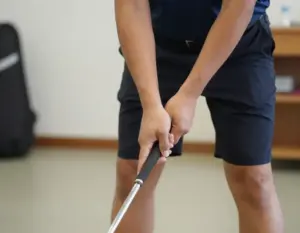
The foundation of every great golf shot begins with proper grip technique. Many female golfers struggle with inconsistent ball contact due to grip issues that create clubface control problems throughout the swing.
The Neutral Grip Setup:
- Position the club handle diagonally across the fingers of your left hand
- Ensure the “V” formed by your thumb and index finger points toward your right shoulder
- Place your right hand with the palm facing the target
- Interlock or overlap your pinky finger based on hand size and comfort
Common Grip Mistakes to Avoid:
- Too weak: Both hands rotated too far left on the handle
- Too strong: Hands rotated excessively right, causing hooks
- Inconsistent pressure: Gripping too tightly restricts swing flow
💡 Pro Tip: Practice your grip daily for 5 minutes without hitting balls. Muscle memory develops faster when you can focus solely on hand positioning without swing mechanics.
2. Establish Rock-Solid Stance and Alignment

Proper setup position directly impacts swing path and ball direction. Professional female golfers emphasize stance width and weight distribution as critical factors for power generation and accuracy.
Optimal Stance Fundamentals:
- Feet shoulder-width apart for driver, slightly narrower for irons
- Weight evenly distributed between both feet
- Slight knee flex with athletic posture
- Spine tilted away from target (right shoulder lower than left)
Alignment Checkpoint System:
- Clubface alignment: Square to target line
- Foot alignment: Parallel left of target
- Hip alignment: Matching foot line
- Shoulder alignment: Slightly open to promote proper swing plane
Research from the LPGA Teaching Division shows that 78% of amateur scoring improvements stem from better setup positions rather than swing changes.
Mastering Scoring Opportunities: Short Game Excellence
3. Develop Consistent Chipping Technique

The area within 50 yards of the green presents the greatest scoring opportunities for immediate improvement. Professional female golfers typically get up-and-down 65% of the time from greenside positions, compared to 25% for amateur players.
Fundamental Chipping Setup:
- Ball position: Slightly back of center in stance
- Weight distribution: 60% on front foot
- Hands ahead of ball at address and impact
- Minimal wrist action through impact
Club Selection Strategy:
| Distance to Pin | Club Choice | Ball Flight | Roll Ratio |
|---|---|---|---|
| 10-15 yards | Sand Wedge | High, soft | 1:1 |
| 15-25 yards | Pitching Wedge | Medium | 1:2 |
| 25-40 yards | 8 or 9 Iron | Lower | 1:3 |
Practice Drill: Set up three targets at 15, 25, and 35 yards. Hit 10 balls to each target with appropriate club selection. Track how many balls finish within 6 feet of each target.
4. Transform Your Putting for Instant Results

Putting accounts for approximately 40% of total strokes in a typical round, making it the fastest route to lower scores. Female golfers often struggle with distance control more than direction, requiring specific focus on tempo and rhythm.
Distance Control Fundamentals:
- Maintain consistent tempo regardless of putt length
- Use pendulum motion with shoulders, not hands
- Practice the “1-2” rhythm: one count back, two counts through
- Focus on rolling the ball, not hitting it
Reading Greens Like a Pro:
- Overall slope: Walk behind the ball to see general green tilt
- Break assessment: Look from both sides of the hole
- Speed consideration: Faster greens require less break reading
- Grain direction: Ball rolls faster with the grain
“The difference between a good round and a great round usually comes down to making those 6-8 foot putts consistently. Master your distance control, and the direction takes care of itself.” – LPGA Tour Professional
Strategic Course Management for Lower Scores
5. Play to Your Strengths with Smart Course Management

Intelligent course management can immediately reduce scores by 3-5 strokes without any swing improvements. This involves making strategic decisions that maximize your strengths while minimizing exposure to your weaknesses.
Tee Shot Strategy:
- Choose clubs that ensure fairway contact over maximum distance
- Aim for the widest part of the fairway, not necessarily the center
- Consider hazard placement and your typical shot patterns
- Use course yardage books to identify optimal landing areas
Approach Shot Decision-Making:
- Always aim for the center of greens unless pin position is easily accessible
- Consider your comfortable yardages when laying up
- Factor in wind conditions and green firmness
- Choose clubs that ensure solid contact over forcing longer shots
Risk vs. Reward Assessment:
- Low-risk plays: Center of fairways, middle of greens, conservative club selection
- High-risk plays: Tight pin positions, forced carries, maximum distance attempts
- Smart aggression: Attack pins only when you have your favorite yardage and good lie
6. Develop Pre-Shot Routines for Consistency
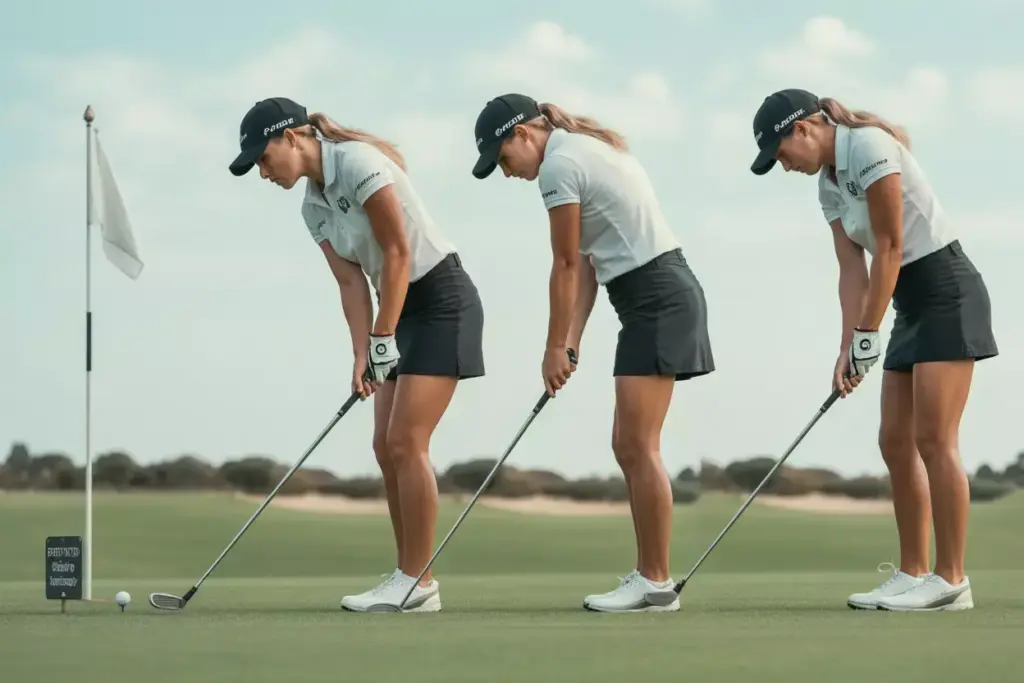
Consistent pre-shot routines eliminate indecision and promote confident swings. Professional female golfers follow identical routines for every shot, creating mental and physical preparation patterns.
Effective Pre-Shot Routine Components:
- Target selection (5 seconds): Pick specific target, not general area
- Club selection (10 seconds): Choose club based on conditions and comfort
- Practice swing (10 seconds): Feel the swing needed for the shot
- Address position (8 seconds): Set up with confidence
- Swing execution (3 seconds): Commit fully to the shot
Mental Preparation Elements:
- Visualize the ball flight and landing area
- Take deep breaths to manage tension
- Use positive self-talk and affirmations
- Focus on process, not outcome
Studies show that golfers with consistent pre-shot routines score an average of 4.2 strokes better than those without established routines.
Advanced Techniques for Immediate Improvement
7. Master Your Swing Tempo and Rhythm

Proper swing tempo is often overlooked but provides immediate results for female golfers. Many amateur players swing too quickly, especially under pressure, leading to inconsistent contact and directional issues.
Optimal Tempo Characteristics:
- Backswing should be deliberate, not rushed
- Transition from backswing to downswing should be smooth
- Acceleration through impact, not at the start of downswing
- Follow-through should be balanced and controlled
Tempo Training Methods:
- Metronome practice: Use 76 beats per minute for full swings
- Counting method: “One-thousand-one” for backswing, “two” for downswing
- Music rhythm: Practice swinging to your favorite moderate-tempo songs
- Heavy club drills: Swing a weighted club to feel proper sequencing
Pressure Management:
During competitive rounds or when scores matter most, many golfers unconsciously speed up their tempo. Professional female golfers combat this by:
- Taking extra practice swings to feel proper rhythm
- Using breathing techniques between shots
- Focusing on smooth acceleration rather than power
- Maintaining the same pre-shot routine regardless of situation
Physical Conditioning for Better Golf:
- Flexibility exercises: Improve shoulder and hip rotation
- Core strengthening: Better stability leads to more consistent contact
- Balance training: Single-leg exercises enhance swing stability
- Cardiovascular fitness: Maintain energy and focus throughout 18 holes
Building Your Improvement Plan
Creating Effective Practice Sessions
Structured practice accelerates improvement more than random ball-hitting sessions. Professional female golfers dedicate specific time percentages to different aspects of their games.
Optimal Practice Time Distribution:
- 40% Short game: Putting, chipping, pitching within 100 yards
- 30% Full swing: Range work with specific targets and objectives
- 20% Course management: On-course practice and strategy work
- 10% Physical conditioning: Flexibility, strength, and balance training
Weekly Practice Schedule Example:
| Day | Focus Area | Duration | Specific Activities |
|---|---|---|---|
| Monday | Putting | 45 min | Distance control, breaking putts |
| Tuesday | Full swing | 60 min | Driver and iron accuracy |
| Wednesday | Short game | 45 min | Chipping and pitching variety |
| Thursday | Course play | 3-4 hours | Apply techniques in real situations |
| Friday | Mental game | 30 min | Visualization and routine practice |
| Weekend | Competitive play | 4-5 hours | Tournament or serious recreational rounds |
Tracking Your Progress
Measurable improvement requires consistent tracking of key performance indicators. Use these metrics to monitor your progress with the seven pro golf tips:
Essential Statistics to Track:
- Fairways hit: Target 60%+ for immediate scoring improvement
- Greens in regulation: Aim for 40%+ as intermediate goal
- Putts per round: Reduce to 32-34 for significant score drops
- Up-and-down percentage: Target 35%+ from greenside positions
- Three-putt avoidance: Eliminate to save 2-3 strokes per round
Conclusion
Implementing these 7 pro golf tips for women to immediately lower your score provides a clear pathway to better golf without requiring months of swing reconstruction. The beauty of these techniques lies in their immediate applicability—you can start seeing results in your very next round.
Your Action Plan for Success:
- Start with fundamentals: Spend this week perfecting your grip and setup position
- Prioritize short game: Dedicate 60% of practice time to shots within 100 yards
- Develop course strategy: Plan each hole based on your strengths and typical miss patterns
- Create consistent routines: Establish and practice your pre-shot routine until it becomes automatic
- Focus on tempo: Use counting or rhythm methods to maintain consistent swing speed
- Track your progress: Record key statistics to measure improvement objectively
- Practice with purpose: Follow structured practice sessions rather than aimless range time
Remember that professional female golfers didn’t achieve success overnight, but they did focus on the fundamentals that create consistent results. By implementing these seven strategies systematically, you’ll join the ranks of golfers who have discovered that lower scores come from smarter play, not just longer drives.
The golf course awaits your improved game. Take these proven techniques, apply them with dedication, and watch as your scores drop and your confidence soars. Your best golf is just one round away.