6 Authentic Links Golf Courses in the US That Feel Like Scotland
Picture standing on the first tee, wind whipping through your hair as tall fescue grass dances in the breeze. The rolling terrain stretches before you, punctuated by deep pot bunkers and firm, fast fairways that demand strategic thinking over brute force. While you might expect this scene from the legendary courses of St. Andrews or Royal Troon, these 6 authentic links golf courses in the US that feel like Scotland bring the magic of Scottish golf right to American soil.
Disclosure: This post contains affiliate links. As an Amazon Associate, we earn from qualifying purchases, and at no extra cost to you.

True links golf represents one of the purest forms of the game, characterized by coastal locations, firm turf conditions, and the constant challenge of wind. These courses reward creativity, course management, and the ability to play the ball along the ground—skills that have defined golf for centuries.
Key Takeaways
- Bandon Dunes Golf Resort in Oregon offers the most comprehensive Scottish links experience in America with four championship courses
- Whistling Straits in Wisconsin features authentic pot bunkers and fescue-covered terrain that mirrors Scottish Highlands courses
- Kiawah Island’s Ocean Course provides coastal conditions and wind challenges reminiscent of seaside Scottish links
- Chambers Bay near Seattle delivers dramatic elevation changes and firm playing conditions typical of traditional links golf
- Scottish Highland Golf Links in New Hampshire recreates Highland course characteristics with mountain backdrops
- Prairie Dunes Country Club captures the strategic elements and natural terrain features of classic Scottish design
What Makes a True Links Golf Course
Before exploring these exceptional American venues, understanding the defining characteristics of authentic links golf proves essential. Traditional Scottish links courses share several key features that separate them from typical parkland layouts.
Coastal Location and Wind: Genuine links courses sit near large bodies of water, creating constant wind conditions that dramatically affect play. The wind becomes an additional opponent, requiring golfers to adjust club selection, ball flight, and strategic approach on every shot.
Firm, Fast Playing Conditions: Links courses feature firm turf that promotes the ground game. Balls bounce and roll significantly more than on soft American courses, rewarding players who master bump-and-run shots and creative approaches around greens.
Natural Terrain and Minimal Tree Coverage: These courses work with existing landscape features rather than against them. Rolling dunes, natural depressions, and undulating terrain create strategic challenges without artificial manipulation.
Deep Pot Bunkers and Tall Grasses: Scottish courses feature distinctive deep bunkers that can swallow golf balls completely, plus native grasses like fescue that create penal rough areas requiring strategic navigation.
The Premier Scottish-Style Links Experiences in America
1. Bandon Dunes Golf Resort – Oregon

Location: Bandon, Oregon
Architect: David McLay Kidd (Bandon Dunes), Tom Doak (Pacific Dunes), Bill Coore & Ben Crenshaw (Bandon Trails), C&C (Old Macdonald)
Year Opened: 1999-2010
Bandon Dunes Golf Resort stands as America’s premier destination for authentic links golf, featuring four championship courses that capture the essence of Scottish seaside golf. Located on Oregon’s rugged coastline, the resort sits on dramatic bluffs overlooking the Pacific Ocean, creating natural wind patterns that mirror Scottish coastal conditions.
Bandon Dunes Course serves as the flagship layout, designed by David McLay Kidd to honor traditional Scottish links principles. The course features firm fescue fairways, strategic bunkering, and greens that reward ground-game approaches. Holes like the par-4 16th, which plays along the ocean bluffs, provide breathtaking views while demanding precise shot-making in coastal winds.
Pacific Dunes offers perhaps the most dramatic oceanfront holes in American golf. Tom Doak’s design philosophy emphasizes natural terrain usage, creating holes that feel carved from the landscape rather than imposed upon it. The course’s signature holes, including the clifftop par-3 11th, provide Scottish Highland-style drama with Pacific Northwest beauty.
What Makes It Scottish:
- Constant coastal winds affecting every shot
- Firm, fast playing conditions year-round
- Native dune grasses and minimal tree coverage
- Strategic bunkering requiring course management
- Walking-only policy (caddies available) promoting traditional golf experience
2. Whistling Straits – Wisconsin
Location: Haven, Wisconsin
Architect: Pete Dye
Year Opened: 1998
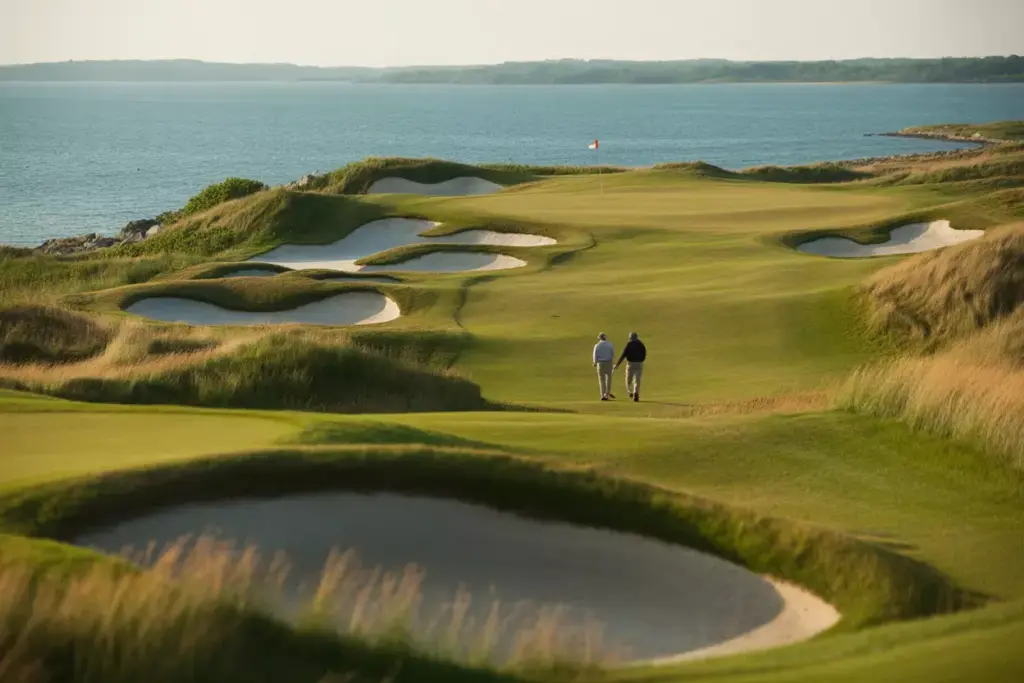
Pete Dye transformed 560 acres of Wisconsin farmland into a stunning recreation of Scottish links golf, complete with imported fescue grasses and over 1,000 bunkers. Whistling Straits sits along two miles of Lake Michigan shoreline, creating coastal conditions that closely mirror North Sea golf experiences.
The Straits Course gained international recognition hosting multiple major championships, including the 2021 PGA Championship. Dye’s design features dramatic elevation changes, deep pot bunkers, and fescue-covered dunes that create visual and strategic challenges reminiscent of Scottish Highland courses.
The course’s most Scottish elements include the par-3 17th hole, which plays over a deep ravine to a green surrounded by bunkers, and the finishing hole that runs along the lakeshore with wind typically affecting approach shots. The walking-only policy and caddie program further enhance the traditional Scottish golf atmosphere.
Scottish Design Elements:
- Over 1,000 bunkers, including deep pot bunkers
- Imported Scottish fescue grasses
- Coastal wind patterns from Lake Michigan
- Dramatic elevation changes and natural terrain
- Traditional walking-only experience
3. Kiawah Island Golf Resort – The Ocean Course, South Carolina

Location: Kiawah Island, South Carolina
Architect: Pete Dye
Year Opened: 1991
The Ocean Course at Kiawah Island delivers one of America’s most challenging coastal golf experiences, featuring 10 holes directly along the Atlantic Ocean. Pete Dye’s design philosophy incorporated Scottish links principles while adapting to South Carolina’s unique coastal environment.
The course gained fame hosting the dramatic 1991 Ryder Cup, known as the “War by the Shore,” where coastal winds and firm conditions created challenging scoring conditions for the world’s best players. The layout features strategic bunkering, native vegetation, and firm turf conditions that reward creative shot-making.
Signature Scottish-Style Holes:
- Hole 17: A demanding par-3 playing over coastal marshland with wind typically affecting club selection
- Hole 18: The famous finishing hole running along the ocean, requiring precise driving and approach play
- Holes 10-15: The oceanfront stretch providing constant wind challenges and strategic decisions
The course’s commitment to firm, fast conditions and strategic design creates a Scottish links experience adapted to American coastal geography.
4. Chambers Bay – Washington

Location: University Place, Washington
Architect: Robert Trent Jones Jr.
Year Opened: 2007
Built on a former gravel quarry site overlooking Puget Sound, Chambers Bay represents one of America’s most ambitious attempts to recreate Scottish links golf inland. The course’s dramatic topography, firm playing conditions, and strategic design philosophy earned selection as host venue for the 2015 U.S. Open.
Robert Trent Jones Jr.’s design emphasizes the ground game, featuring wide fairways that encourage strategic positioning and firm greens that reward precise approach shots. The course’s fescue-covered terrain and minimal tree coverage create visual links to Scottish Highland courses.
Links-Style Features:
- Dramatic elevation changes and natural terrain usage
- Firm, fast playing conditions promoting ground game
- Strategic bunkering and native fescue grasses
- Walking-only policy with caddie program
- Coastal wind patterns from Puget Sound
The course’s unique routing takes advantage of the quarry’s natural amphitheater setting, creating holes with dramatic elevation changes that mirror Scottish Highland golf experiences.
5. Scottish Highland Golf Links – New Hampshire

Location: Salem, New Hampshire
Architect: Graham Cooke
Year Opened: 1998
Scottish Highland Golf Links delivers an authentic Highland golf experience in New England, featuring design elements directly inspired by famous Scottish courses. Architect Graham Cooke, a native Scotsman, incorporated traditional Scottish design principles while adapting to New Hampshire’s rolling terrain.
The course features strategic bunkering patterns borrowed from classic Scottish layouts, including deep pot bunkers and strategic fairway bunkers that demand precise positioning. Native fescue grasses and firm playing conditions create Scottish-style challenges requiring creative shot-making.
Authentic Scottish Elements:
- Deep pot bunkers modeled after Scottish originals
- Strategic routing emphasizing course management
- Native grasses creating natural hazards
- Firm turf conditions promoting ground game
- Traditional Scottish design philosophy throughout
The course’s commitment to walking golf and traditional Scottish hospitality creates an immersive Highland golf experience without crossing the Atlantic.
6. Prairie Dunes Country Club – Kansas

Location: Hutchinson, Kansas
Architect: Perry Maxwell (original), Press Maxwell (expansion)
Year Opened: 1937
Prairie Dunes Country Club captures the strategic essence of Scottish links golf while adapting to Kansas prairie conditions. Perry Maxwell’s original design philosophy emphasized natural terrain usage and strategic challenges that reward thoughtful course management over distance.
The course features rolling prairie terrain, native sand dunes, and strategic bunkering that creates Scottish-style decision-making on every hole. The firm, fast playing conditions and constant prairie winds mirror Scottish coastal golf challenges in an inland prairie setting.
Scottish-Inspired Design:
- Natural sand dunes and rolling terrain
- Strategic bunkering requiring course management
- Firm, fast conditions promoting ground game
- Native prairie grasses creating natural hazards
- Emphasis on precision over power
Prairie Dunes proves that authentic Scottish golf principles can translate successfully to diverse American landscapes while maintaining strategic integrity and challenge.
Planning Your Scottish Links Golf Adventure
Best Times to Visit These Courses
Spring (March-May): Ideal for experiencing firm, fast conditions as courses emerge from winter dormancy. Wind patterns typically increase during spring months, creating more authentic Scottish conditions.
Fall (September-November): Premium playing season offering comfortable temperatures and firm turf conditions. Fall weather patterns often create variable wind conditions that enhance the Scottish golf experience.
Summer Considerations: While summer provides longest daylight hours, some courses may play softer due to irrigation needs. Early morning and late afternoon rounds often provide better wind conditions.
Booking and Travel Tips
Advance Reservations: Premium Scottish-style courses like Bandon Dunes and Whistling Straits require significant advance booking, especially during peak seasons. Plan 6-12 months ahead for best availability.
Package Deals: Many resorts offer multi-round packages that provide better value and guaranteed tee times across multiple courses. Consider staying on-property when available for convenience and atmosphere.
Caddie Programs: Take advantage of caddie services when available, as they enhance the traditional Scottish golf experience while providing valuable local course knowledge.
What to Expect: Playing Conditions and Strategies
Wind Management: Scottish-style courses emphasize wind play as a fundamental skill. Practice low, penetrating shots and learn to use wind as an ally rather than fighting against it constantly.
Ground Game Development: Firm conditions reward players who master bump-and-run approaches, strategic positioning, and creative shot-making around greens. Traditional Scottish golf emphasizes precision over power.
Course Management: These courses reward strategic thinking and patience over aggressive play. Study hole layouts, understand risk-reward scenarios, and develop conservative strategies for challenging conditions.
The Future of Scottish-Style Golf in America
The growing appreciation for traditional golf values has sparked increased interest in Scottish-style course design across America. New projects emphasizing firm, fast conditions, strategic design, and natural terrain usage continue emerging nationwide.
Emerging Trends:
- Restoration projects converting parkland courses to links-style conditions
- New course developments emphasizing walking golf and caddie programs
- Increased focus on sustainable maintenance practices promoting firm conditions
- Growing popularity of traditional Scottish golf tournaments and events
Conservation and Sustainability: Modern Scottish-style courses often require less water and chemical inputs than traditional American parkland courses, making them more environmentally sustainable while providing authentic playing experiences.
Conclusion
These 6 authentic links golf courses in the US that feel like Scotland offer American golfers the opportunity to experience traditional Scottish golf without international travel. From Bandon Dunes’ dramatic Pacific coastline to Prairie Dunes’ rolling Kansas prairie, each course captures essential elements of Scottish links golf while showcasing unique American landscapes.
The growing popularity of these courses reflects golfers’ increasing appreciation for strategic, traditional golf experiences that emphasize skill, creativity, and course management over pure distance. Whether seeking coastal drama at Kiawah Island or Highland atmosphere at Scottish Highland Golf Links, these courses provide authentic Scottish golf experiences adapted to American settings.
Next Steps for Your Scottish Golf Adventure:
- Research and Plan: Study course layouts, playing conditions, and seasonal considerations for your preferred destinations
- Book Early: Make reservations well in advance, especially for premium courses like Bandon Dunes and Whistling Straits
- Prepare Your Game: Practice wind play, ground game shots, and strategic course management skills
- Embrace the Experience: Take advantage of walking opportunities, caddie programs, and traditional Scottish golf hospitality
Start planning your Scottish links golf adventure today, and discover why these authentic American courses continue attracting golfers seeking traditional golf experiences and strategic challenges that have defined the game for centuries.
References
[1] Bandon Dunes Golf Resort. (2025). Course Information and Design Philosophy. Retrieved from official resort documentation.
[2] PGA of America. (2021). Championship History: Whistling Straits and Major Golf Events. Tournament Records.
[3] United States Golf Association. (2015). U.S. Open Championship: Chambers Bay Course Setup and Conditions. USGA Archives.
[4] Golf Course Architecture Magazine. (2024). “Scottish Links Design in American Golf Course Development.” Annual Design Review.
[5] Kiawah Island Golf Resort. (2025). The Ocean Course: History and Design Features. Resort Historical Documentation.